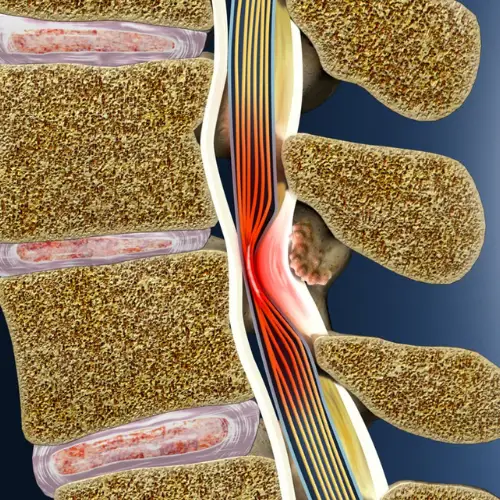
A spinal disc herniation, commonly called a ‘slipped disc,’ refers to a prolapse of inner disc material through the outer disc. Typically, this condition occurs when a tear in the tough, outermost layer of the disc (the annulus fibrosus) allows the soft, jellylike material within the disc (the nucleus pulposus) to bulge through the external wall of the disc.

Symptoms

Tears in the annulus fibrosus may cause severe pain due to release of inflammatory chemical mediators. Pain may also arise when these tears permit nerves on the periphery of the disc to grow into the disc and become painful. Disc herniation may also cause pain when bulging disc material compresses adjacent structures such as the spinal cord and nerve roots.

In addition to pain, individuals with herniated discs may experience numbness, burning and tingling. These symptoms are likewise due to nerve irritation. Some individuals may develop sciatica, a condition involving shooting pain, numbness, burning, or tingling along the nerve that runs down the back of the leg.

Conversely, some people with disc herniation may experience no symptoms1. Generally, in asymptomatic cases of herniated disc the extruded nucleus pulposus does not compress surrounding structures.

Risk Factors

As an individual grows older, intervertebral discs gradually lose their water content. This reduces their flexibility and capacity to absorb shock. Gradual loss of fluid may also predispose the discs to tears, which may cause disc herniations. Gradual, age-related deterioration of the spinal discs is called degenerative disc disease (DDD)2. Although DDD may occur anywhere in the spine, it commonly affects the low back and the neck, which are common sites of disc herniation.

In addition, disc herniations occur more frequently in people who bear weight3, which may increase intradiscal pressure4. Other risk factors for disc herniation may include high body mass index (BMI)5, smoking6, and atherosclerosis7. For example, a study of 344 people who had an MRI and completed low back pain questionnaires at the age of 40 and again at 44 years found that disc-related MRI findings including disc herniations were concurrent with certain lifestyle factors (e.g., high physical work, high BMI, and heavy smoking)8. In the case of atherosclerosis, insufficient blood supply to the disc has been proposed to play a role as causative factor in disc herniation. A study supporting this assumption found an association between high cholesterol and triglyceride levels and symptomatic disc herniation9.

Diagnosis

Generally, doctors use imaging studies to help visualize whether a person’s pain is being caused by a herniated disc. Such studies may include MRI, CT scan and X-ray.

Sometimes a herniated disc may be diagnosed through discography, a diagnostic interventional procedure performed to confirm or refute the hypothesis that a specific disc is the predominant source of a patient's back pain10. In discography, a special dye is injected into the disc, allowing the practitioner to scrutinize the disc on x-ray film. Another diagnostic component of discography is pressure exerted by the injection, which the practitioner applies to determine whether the disc being tested is causing the patient’s pain.

Treatment

Most disc herniations heal by themselves within a few weeks. However, a range of interventions are recommended to individuals whose disc herniations are painful. In general, pain management in disc herniation relies initially on conservative care, with more invasive procedures reserved as a last resort11.

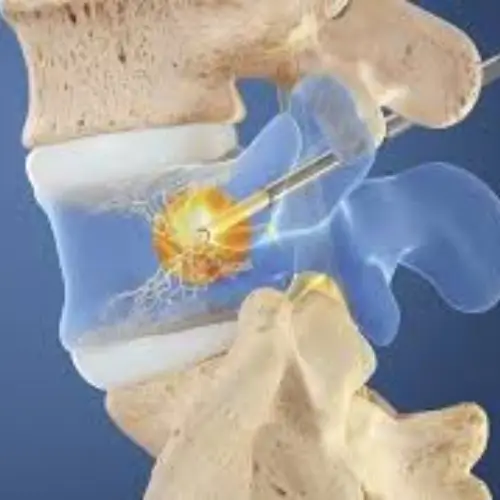
Common interventions for herniated disc may include administration of drugs that reduce inflammation, such as non-steroidal anti-inflammatory drugs (NSAIDs), physical therapy, epidural steroid injections (injection of a steroid into the epidural space of the spinal cord surrounding irritated nerve roots, reducing inflammation and irritation), and percutaneous discectomy (suctioning material out of a bulging disc, relieving pressure within the disc). When more conservative measures fail, surgery may be considered as a last resort. Typically, surgical procedures are recommended in serious cases involving severe, symptomatic compression of the spinal cord and nerve roots.

Intervertebral discs deteriorate with time, from the nucleus pulposus outwards. Age-related deterioration can be accelerated by physical disruption, which can lead to disc herniation12. Disc herniations can cause significant pain. In general, research indicates a healthy lifestyle that promotes acceptable BMI, cardiovascular well-being, safe lifting of weight, and avoidance of smoking can help lower the risk of disc herniation and other forms of disc degeneration.

References

  1. Ernst CW, Stadnik TW, Peeters E, Breucq C, & Osteaux MJ. (2005). Prevalence of annular tears and disc herniations on MR images of the cervical spine in symptom free volunteers. Eur J Radiol., 55(3), 409-14.
  2. Smith, LJ, Nerurkar, NL, Choi, KS, Harfe, BD, & Elliott, DM. (2011). Degeneration and regeneration of the intervertebral disc: lessons from development. Dis Model Mech., 4(1), 31-41.
  3. Suri P, Hunter DJ, Jouve C, Hartigan C, Limke J, Pena E, Swaim B, Li L, & Rainville J. (2010). Inciting events associated with lumbar disc herniation. Spine J., 10(5), 388-95.
  4. Flamme CH. (2005).[Obesity and low back pain--biology, biomechanics and epidemiology].[Article in German]. Orthopade., 34(7), 652-7.
  5. Böstman OM. (1993). Body mass index and height in patients requiring surgery for lumbar intervertebral disc herniation. Spine (Phila Pa 1976)., 18(7), 851-4.
  6. Kauppila LI. (2009). Atherosclerosis and disc degeneration/low-back pain--a systematic review. Eur J Vasc Endovasc Surg., 37(6), 661-70.
  7. Jhawar BS, Fuchs CS, Colditz GA, & Stampfer MJ. (2006). Cardiovascular risk factors for physician-diagnosed lumbar disc herniation. Spine J., 6(6), 684-91.
  8. Jensen TS, Kjaer P, Korsholm L, Bendix T, Sorensen JS, Manniche C, & Leboeuf-Yde C. (2010). Predictors of new vertebral endplate signal (Modic) changes in the general population. Eur Spine J., 19(1):129-35.
  9. Longo UG, Denaro L, Spiezia F, Forriol F, Maffulli N, & Denaro V. (2011). Symptomatic disc herniation and serum lipid levels. Eur Spine J., 2011 Mar 9. [Epub ahead of print]
  10. Stout A. (2010). Discography. Phys Med Rehabil Clin N Am., 21(4), 859-67.
  11. Gangi A, Tsoumakidou G, Buy X, Cabral JF, & Garnon J.(2011). Percutaneous techniques for cervical pain of discal origin. Semin Musculoskelet Radiol., 15(2), 172-80.
  12. Adams MA, Stefanakis M, & Dolan P. (2010). Healing of a painful intervertebral disc should not be confused with reversing disc degeneration: implications for physical therapies for discogenic back pain. Clin Biomech (Bristol, Avon)., 25(10), 961-71.

Add comment


Security code
Refresh

Who's Online

We have 240 guests online